Holocaust persecution of Jews
The Glass RoomHolocaust persecution of Jews is rendered through intimate disruptions: a family taken away in the night, a husband deported and murdered, a mother detained while her child is left behind, and survivors struggling for decades to recover the missing. The novel sets these experiences against the evasions and distortions of public memory, showing persecution not as an abstraction but as a force that breaks relationships and makes ordinary knowledge of the past difficult to recover.
Deportation and the loss of family
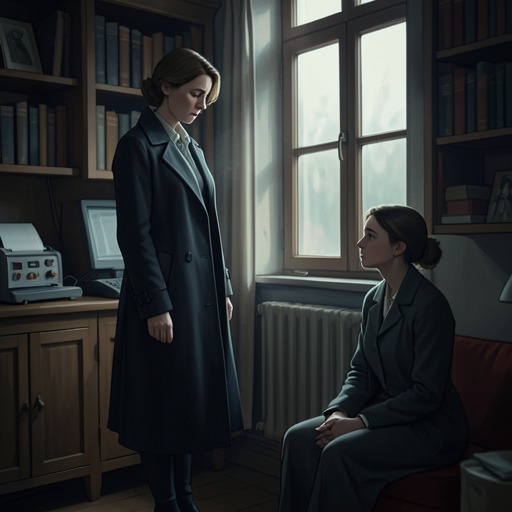
Hana recalls that the Gestapo came to her home during the night and took both her and her husband, Oskar. She does not know why they were targeted, or what happened to him immediately after their arrest. Only after the war did she learn that he had been sent to Theresienstadt. The account holds together what she knows and what remains unknowable: the arrest is clear, but the reasons and the immediate fate of her husband are not.
Hana later learned that Oskar spent about a year in Theresienstadt before being sent on a transport to Auschwitz in January 1943. She believes he did not survive. Naming him, and recalling that he was much older than she was, gives the lost husband an individual place within a history that might otherwise reduce him to a deportation and a destination. Hana says that she had betrayed him many times, yet he was the only man she ever loved; the confession makes the surviving relationship inseparable from guilt and loss.
Persecution in the lives of the displaced
The novel also presents persecution through the unstable circumstances of refugees. At a public gathering in the Glass Room, three adults and three children are brought before an audience, their appearance turning the room into something like a small theatre. Among them is Katalin, a mother with a young daughter, Marika. The children and adults are made to stand while the committee’s secretary directs them, and the audience looks them over. The staging exposes the imbalance between those who can watch and those whose displacement has made them objects of scrutiny.
Katalin’s account of an earlier period in Vienna makes clear how poverty and vulnerability shaped her choices. She says Viktor helped her financially when she could not find work, pay rent, or afford clothes for her baby. She does not express shame for accepting the money: the alternative was a life in which the next meal and a place to sleep were uncertain. Her circumstances give material weight to the word refugee, showing how a precarious existence can begin before a formal arrest or border detention.
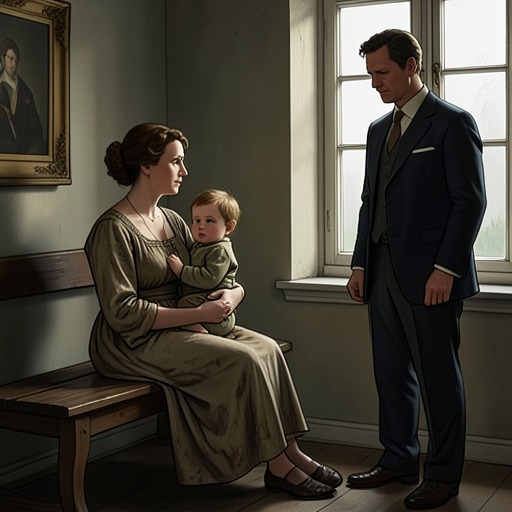
At a later inspection, Katalin presents a passport and visas, but officials examine her papers and take her away toward a nearby hut. Viktor says she is employed by his family; the soldier refuses to let him speak for her. Marika calls for her mother, while Liesel pulls the child close and assures officials that Marika is with the family and will be looked after. The separation unfolds quickly, leaving the child dependent on the protection of others while her mother is removed from view.
Jewish identity and the challenge to indifference
The persecution also enters the novel through the encounter between private intimacy and public ideology. When a woman is pressed about why the Jews are being isolated, she answers that her husband is Jewish. Her response turns the policy from a supposedly abstract question into a fact of marriage and family. The moment forces the listener to confront the human relationship that the language of isolation would obscure.
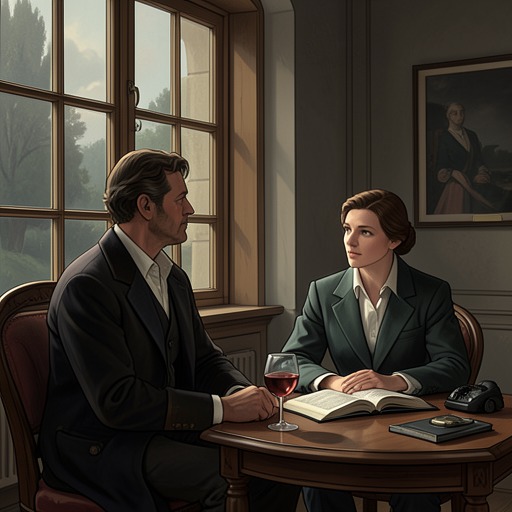
A later conversation in the former Landauer home gives this history another, more compressed form. Asked what happened to the family who once lived there, Hana answers that the husband was Jewish. The plainness of the reply carries the weight of what Zdenka has not been taught to remember. Zdenka recalls the Jewish cemetery of her childhood and a visit to Theresienstadt as a young person, where she wondered why the museum commemorated resistance while the Jews had been left to die. Persecution thus persists not only in survivors’ memories but also in the omissions through which a society remembers its past.
Survival, exile, and belated knowledge
For the Landor family, the news that a woman once believed dead is alive opens a history long obscured by arrest, deportation, and separation. Mrs Landor says that her family heard of the woman’s arrest and deportation in 1942, when they were in Cuba. After the war, the expulsion of Germans and the confusion surrounding displaced people made information difficult to obtain. The family itself had left Moravia, while her husband’s Jewish relatives had been killed in the camps, including Auschwitz, Sobibor, and Treblinka.
The Iron Curtain then made the country seem to have vanished from reach. Decades of uncertainty end not with a recovered account of everything that happened, but with the startling confirmation that the missing woman survived. The scene places survival beside the deaths of relatives and the family’s exile, making reunion meaningful without suggesting that it can repair what persecution destroyed. Across these accounts, the novel links deportation and murder to separation, precarious refuge, and the persistent struggle to make the dead and the missing present in public memory.